
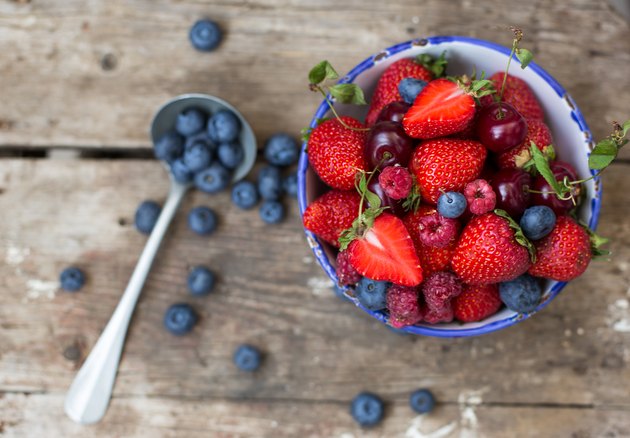
If you want to eat a cup of fruit, calories shouldn't be a reason for concern. Fruits are naturally sweet and can satisfy your cravings without adding inches to your waistline as long as you enjoy them in moderation.
Tip
According to the美国农业部食物为孩子减轻产品信息表ition Programs, 1/2 cup of mixed, canned fruit has about 60 calories. For a 2,000-calorie diet, the daily recommendation is about 2 cups of fruit per day. USDA Food Product Information Sheet for Child Nutrition Programs
1-Cup Mixed Fruit Nutrition
Fruits are promoted as healthy by organizations worldwide. According to July 2012 study published inAdvances in Nutrition, they contain high doses of fiber, vitamins and minerals. Fruits also contain phytochemicals, such as antioxidants,phytoestrogensandanti-inflammatory compounds. If you use a fruit salad calorie calculator, add together the calories of each fruit per serving size. For example:
- Onemedium strawberrycontains 3.8 calories, 0.5 grams of sugar and 2 grams of fiber.
- Onekiwicontains 42.1 calories, 6.2 grams of sugar and 2 grams of fiber.
- Onemedium bananacontains 105 calories, 14.4 grams of sugar and 3 grams of fiber.
- Onemangocontains 202 calories, 45.9 grams of sugar and 5.3 grams of fiber.
The2015-2020 Dietary Guidelines for Americansemphasize that the recommended amount of fruit for a 2,000 calorie diet is 2 cups per day. One cup of 100 percent fruit juice also counts as 1 cup of fruit.
Althoughfruit juicecan be part of a healthy eating pattern, it's lower in dietary fiber than whole fruits. When consumed in excess, it may add extra calories to your diet. Additionally, fruit juice is not the best choice for certain populations, such as children, given the amount of sugar in it.
When selecting canned fruit, choose brands with little or no added sugar. One-half cup of dried fruit counts as a 1-cup equivalent of fruit. Like juice, canned fruits may add unnecessary calories to your diet when consumed in large amounts.
Read more:Top 10 Healthiest Fruits and Vegetables
Fruit and Weight Control
An October 2016 study published inNutrientshas found that increasing fruit intake may positively influence body weight. Additionally, fruits can help you maintain ahealthy lifestyleby satisfying your sweet tooth and reducing your intake of processed sugars and fats.
Still, you must be careful about how much fruit you eat as it containssimple sugarslike glucose, fructose and sucrose. Simple sugars are known to cause weight gain, obesity and obesity-related diseases when consumed in excess. Like most things, fruits should be enjoyed in moderation.
Be aware that food additives, such as heavy cream, sugar, chocolate toppings and other "extras" that you put on or mix with fruits, will increase the calorie count. According to a September 2018 study published inNutrients,the habit of adding sugars to foods commonly perceived as healthy, such as fruit, influences adherence to healthy dietary guidelines. Additionally, it may increase the risk of obesity.
There are many ways to incorporate fruit into your diet besides eating it whole or as a mixed cup, notes theAmerican Heart Association. Try these tricks to boost your fruit intake:
- Add bananas, raisins or berries to cereals.
- Drink a small glass of juice (about 6 ounces). Choose 100 percent fruit juice with no excess sodium or sugar.
- Mix some of your favorite fruits with almond milk for a healthy snack.
- Freeze fruits, such as grapes or bananas, and enjoy them as a snack on a hot day.
- Incorporate fruits into your salads, like cool watermelon chunks and feta salad.
- 果汁的水果在家里去收获他们的好处t the added sugar.
- USDA: "Kiwifruit, Green, Raw"
- USDA: "Strawberries, Raw"
- USDA: "Bananas, Raw"
- USDA: "Mangos, Raw"
- Advances in Nutrition: "Health Benefits of Fruits and Vegetables"
- Health.gov: "Dietary Guidelines for Americans, 2015-2020: "Fruits"
- Nutrients: "Paradoxical Effects of Fruit on Obesity"
- American Heart Association: "How to Eat More Fruit and Vegetables"
- Nutrients: "The Impact of Adding Sugars to Milk and Fruit on Adiposity and Diet Quality in Children: A Cross-Sectional and Longitudinal Analysis of the Identification and Prevention of Dietary- and Lifestyle-Induced Health Effects in Children and Infants (IDEFICS) Study"
- Breast Cancer Prevention Partners: "Phytoestrogens"
- 美国农业部食物为孩子减轻产品信息表ition Programs: "Mixed Fruit, Extra Light Sucrose Syrup, Canned"