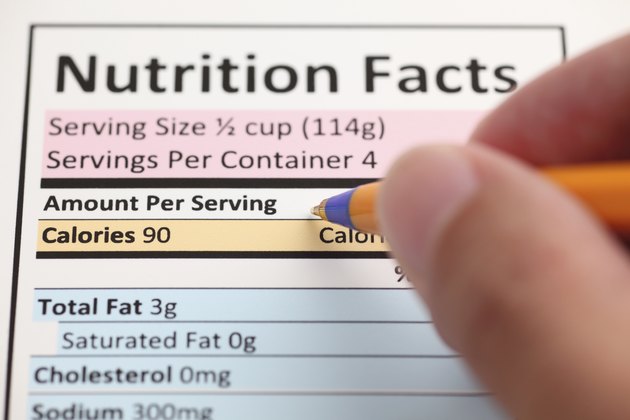
美国食品标签标准要求使用“卡路里”。This is actually the colloquial term for kilocalorie, or kilogram calorie. The term calorie refers to a measurement of energy that comes from the French term "calor," meaning heat. Countries in the European Union use kilojoules on their labels, the joules are the standard measurement of energy. However, the use of calories over joules on American food labels is simply a preference -- think of it as the energy equivalent of using "miles" instead of "kilometers."
千卡
千卡是指食物中的能量。1千卡是将一千克水的温度升高1摄氏度所需要的能量。1千卡相当于1000“小”卡路里,这是将一克水的温度升高1摄氏度所需要的能量。在美国食品标签上,“卡路里”一词实际上是指千卡,虽然从技术上来说,“卡路里”是一个较小的单位。
焦
美国以外的大多数国家在食品标签上使用千焦。一千卡等于4。184千焦。美国农业部的国家营养数据库列出了两者的营养价值。
这两者都需要在一些标签上
欧盟成员国必须同时列出千焦和千卡。根据美国的规定,上市千焦耳是可选的。一种食物的能量含量在标签上通常是按食用分量和100克列出的。
阿特沃特系统
阿特沃特系统通常被食品工业用于美国的标签。这是一个计算碳水化合物、脂肪和蛋白质的能量值的标准。这些千卡用“卡路里”来表示。The system assigns 4 calories per gram to carbohydrates, 9 calories per gram to fats and 4 calories per gram to proteins. Under the EU system, carbs and protein are each assigned 17 kilojoules and fat 37.
其他热量分配
乙醇/酒精、无糖甜味剂和有机酸也有标准。这些千卡也表示为“卡路里”。Ethanol is assigned 7 calories per gram, or 29 kilojoules per gram; sweeteners have 2.4 calories per gram, or 29 kilojoules per gram; and the organic acids have 3 calories per gram, or 13 kilojoules per gram.