The system of power production and distribution for use in the home relies on a series of different types of lines and poles to keep the juice flowing to your big plasma screen. High-voltage lines carry electricity for hundreds of miles, while low-voltage lines do the work of distributing all that power into homes. Most of these lines crisscrossing the nation are above ground and elevated on the familiar poles that dot the landscape.
塔
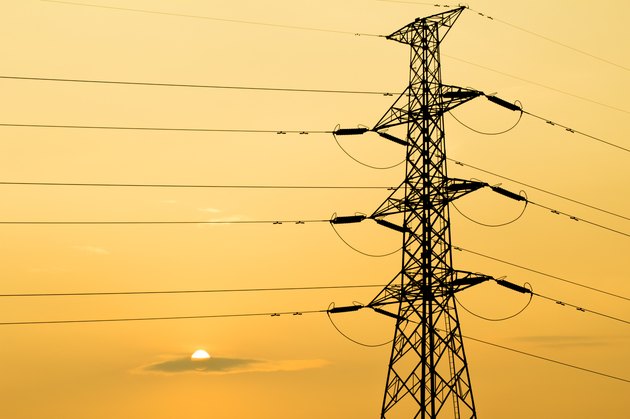
The workhorses of the electricity grid are the steel superstructures that support the high-voltage lines across great open expanses. These towers are familiar to travelers in remote areas, but they are also present in urban areas, usually in industrial sections in town. After the power leaves the generation plant, it passes through a step-up transformer that raises the voltage exponentially to levels as high as 750 kilovolts, according to the Public Service Commission, or PSC, of Wisconsin.
The tower height ranges from about 60 to 140 feet in the United States. While the poles are generally double-circuited, meaning they carry two sets of three transmission lines, a few poles are single-circuited. Most towers are steel, but wood is used for some single-circuit transmission poles. They require a right-of-way of 120 feet, according to the PSC, meaning no trees or structures can be nearer than 60 feet on either side. The lines they hold can span from 800 to 1,000 feet before another support tower is required.
Wooden Poles
高压电力穿过降压变压器在其进入分配网之前。大多数这些分布极是用木头做的。大约有1.34亿木质电线杆在美国,根据美国木材保护协会的估计。他们是第一型电力传输和分配的初期竖立电线杆的。像塔,它们也可以是单极化或双极化,携带的传输线一组或两组。
The criticism of wooden power poles is mostly environmental, stemming from the logging required to harvest the material and the energy required to manufacture and install them. This has led to the use of alternative materials.
Composite Poles
Composite power poles are made from a combination of materials ranging from reclaimed wood or medium-density fiber to plastics and even fiberglass. Composites gained popularity because of the natural resource drain of wooden poles, but manufacturing the composites themselves requires more energy than milling a wooden pole, according to the Environmental Literacy Council. That means that the overall environmental impact of the composite poles may be greater than the wooden standard bearers.
钢柱
Steel is by far the strongest material used in power pole construction, but steel poles require more maintenance than the other varieties. Steel corrodes, shortening the lifespan of the poles, which outweighs the cost benefits gained in the manufacturing process. The National Association of Corrosion Engineers is working to improve mitigation strategies to prolong the life of the poles and prevent premature failure.