Design Pics/Design Pics/Getty Images
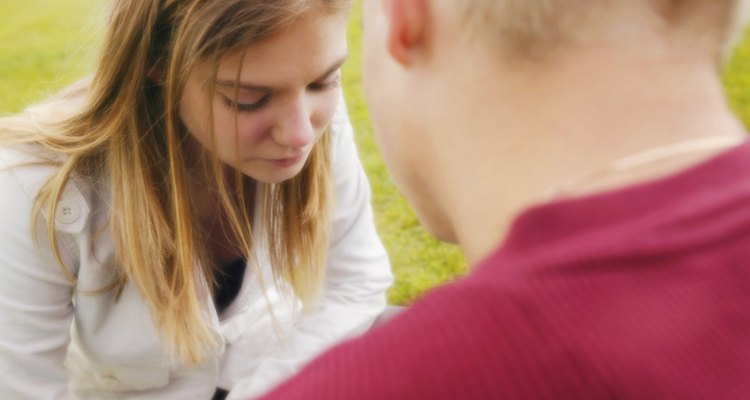
Your facial expressions, body posture, gestures, tone of voice and eye contact are a few ways in which you engage in nonverbal communication. Nonverbal communication can be used alone or alongside verbal communication. Either way, your nonverbal communication can affect the messages you send, your relationships and your cultural interactions and help you negotiate through conversations.
Adding Value
Nonverbal communication can add valuable information to the verbal messages that you are sending. According to Stella Ting-Toomey, writing in “Communicating Across Cultures,” nonverbal signals can be used to complement, emphasize, substitute, and even contradict what you are saying through your verbal communication. Nonverbal signals can place the verbal message in a context that provides a basis for how the message should be interpreted. In addition, nonverbal cues help you to clarify what the other person is trying to say by responding to their words with your nonverbal signals, suggests Ting-Toomey.
Intercultural Friction
Cultural differences can cause nonverbal signals to create friction. According to Ting-Toomey, nonverbal signals mean different things to people from different cultures. The use of multiple nonverbal cues displayed with each message can create confusion, and factors of gender, personality, socioeconomic status and situation can cause the meaning behind the nonverbal signals to vary greatly. Nonverbal communication can be powerful, but when used among non-homogeneous groups the effects can cause confusion and miscommunication.
对人际关系的影响
According to Help Guide, nonverbal cues impact the quality of your relationships and, when used correctly, can improve your relationships. Nonverbal signals can help you gain an accurate reading of others' unspoken feelings and underlying messages, create feelings of trust through the transparency they create and demonstrate understanding and interest, reports Help Guide. If used correctly, nonverbal communication can improve relationships with others, but if it's poorly used, your relationships may suffer through a loss of connections and trust.
Managing Conversation
Lewicki,Barry和Saunders在“谈判的要点”中写道,将行为描述为影响您与他人联系的非语言交流技术。这些行为使其他人知道您正在听,并帮助他们接收您的信息。重要的参加行为包括目光接触,身体位置和鼓励。
Eye contact allows you to tell the other person that you are interested and want to continue the conversation, and lack of eye contact displays your lack of interest and hope that the conversation will end. Adjustments in your body position such as erect, slightly leaning toward the other person and facing each other directly allow for the conversation to continue because both of you are still interested. When you cross your arms or bow your head, you send the message that you disapprove of the information or are through with the conversation. Nonverbal behaviors, such as face-to-face interaction, also enhance your rapport, causing the communication to become more coordinated and have increasingly positive outcomes.
Related Articles

Resentment & Criticism in a Relationship

有效口头交流的要素

What Is Verbal Communication?

How to Be More Comfortable With ...

Verbal Versus Nonverbal Communication

人际关系的十诫

Verbal Vs. Nonverbal Communication

Perceptual Barriers to Communication

Communication in Family Conflicts

Why Do We Need Effective Communication?

有效的交流是双向的...

如何通过...管理冲突...

How to Communicate with Influence
Verbal Communication Tools

Barriers to Effective Verbal ...

How to Repair Your Relationship When ...

How to Change One's Communication Style ...

Examples & Tips for Setting Boundaries ...

How to Explain Something Clearly

How to Build Trust in Relationships ...
参考
- Help Guide: Nonverbal Communication Skills the Power of Body Language
- "Communicating Across Cultures," Stella Ting-Toomey, 1999.
- “谈判的要点,” Roy J. Lewicki,Bruce Barry和David Saunders,2007年。
Writer Bio
Alia Butler holds a Master of Social Work from Washington University, St. Louis, concentrating in mental health, and a Master of Arts in social-organizational psychology from Columbia University. Currently, Butler is a freelance writer, penning articles focusing on mental health, healthy living and issues surrounding work-life balance. She is the principle/owner of ALIA Living, LLC, providing residential interior design services, professional organizing and life coaching.
Photo Credits
Design Pics/Design Pics/Getty Images